How We Scaled an Ecommerce Brand from Zero to $97,079 Revenue in 15 Days Using Meta Ads case study
Launching a new ecommerce brand is difficult here is the meta ads case study for ecommerce growth
Without historical purchase data, proven creatives, customer insights, or optimized audiences, most brands struggle to generate profitable sales in their early stages.
The biggest challenge is not launching a store.
The challenge is finding a scalable customer acquisition system that consistently generates revenue.
In this Meta Ads case study, we’ll break down how our team helped an ecommerce brand go from zero sales to over $97,000 in tracked revenue within just 15 days using a structured Facebook and Instagram advertising strategy.
If you’re looking for a Meta Ads agency that focuses on performance, testing, and scalability, this case study shows exactly how we approach ecommerce growth.
The Challenge
The brand approached us during its launch phase.
Like most newly launched ecommerce businesses, it faced several challenges:
- No purchase history
- No customer data
- No proven audiences
- No validated ad creatives
- No historical pixel data
- No established retargeting assets
This meant Meta’s algorithm had very little information available to optimize for purchases.
Instead of looking for quick wins, our focus was building a foundation that could scale profitably.
Our Meta Ads Strategy
When launching a new ecommerce account, many advertisers make the mistake of scaling too aggressively before finding product-market fit.
Our approach was different.
We focused on three core pillars:
1. Creative Testing
Creative performance determines the success of most Meta campaigns.
We developed multiple creative variations focused on:
- Product benefits
- Problem-solution angles
- Social proof
- Customer experience
- Lifestyle positioning
This allowed us to identify winning messaging quickly and allocate spend toward the highest-performing creatives.
2. Data Collection Phase
The first objective was not scale.
The first objective was data.
We launched multiple testing campaigns designed to gather:
- Purchase signals
- Click behavior
- Engagement patterns
- Audience insights
This accelerated Meta’s learning phase and improved optimization speed.
3. Purchase Optimization
Once sufficient purchase signals were generated, budgets were gradually increased on winning ad sets.
Rather than duplicating campaigns aggressively, we focused on controlled scaling to maintain efficiency and profitability.
Campaign Results
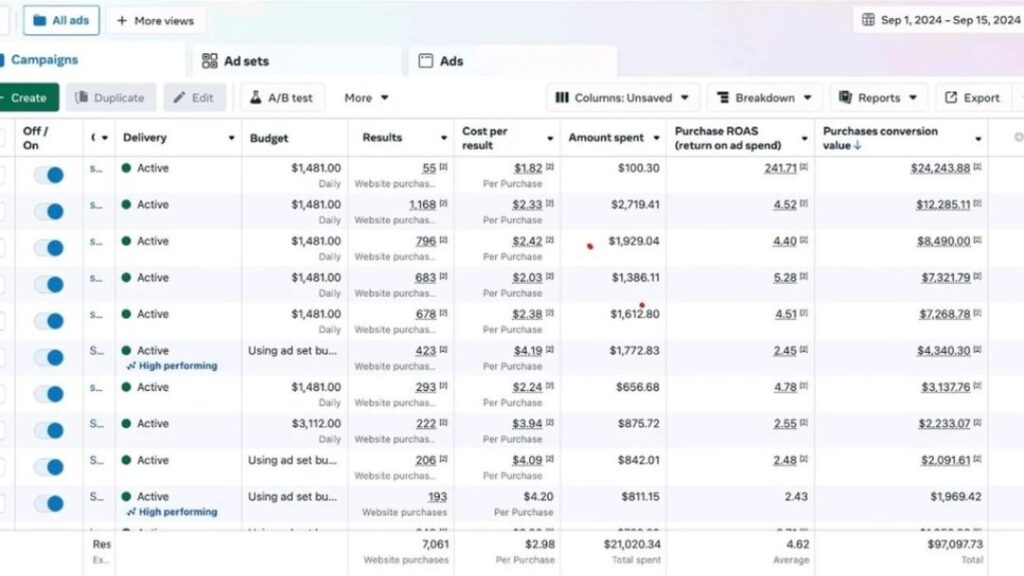
Within the first 15 days, the account achieved:
Revenue Generated
$97,079.27
Total Ad Spend
$21,020.34
Total Purchases
7,061
Average Cost Per Purchase
$2.98
Average Return on Ad Spend (ROAS)
4.62x
These results demonstrate how a structured testing and scaling framework can rapidly accelerate ecommerce growth even without existing customer data.
Top Performing Campaigns
Not all campaigns perform equally.
One of the biggest reasons advertisers struggle with Meta Ads is failing to identify winning assets early.
The strongest-performing campaigns generated:
Campaign #4
- Spend: $1,386
- ROAS: 5.28x
Key takeaway:
This campaign demonstrated exceptional profitability and became a primary candidate for scaling.
Campaign #2
- Spend: $2,719
- ROAS: 4.52x
Key takeaway:
Consistent purchase volume with strong efficiency.
Campaign #5
- Spend: $1,613
- ROAS: 4.51x
Key takeaway:
Stable performance and strong scaling potential.
Why Some Campaigns Underperformed
Many business owners assume every campaign should generate a high ROAS immediately.
That is not how successful Meta advertising works.
Several test campaigns produced ROAS below 3x during the testing phase.
This is normal.
Testing is not wasted budget.
Testing is how winning campaigns are discovered.
We observed that lower-performing campaigns were primarily impacted by:
- Creative fatigue
- Narrow audience targeting
- Early-stage optimization limitations
- Insufficient purchase data
These insights allowed us to redirect spend toward stronger-performing ad sets and improve overall account efficiency.
Scaling Strategy Moving Forward
Once profitable campaigns emerged, the next phase focused on sustainable growth.
Our recommendations included:
Increase Budgets Gradually
Winning campaigns should be scaled incrementally by 20–30% per week to avoid disrupting Meta’s learning phase.
Expand Retargeting
Retargeting audiences were built around:
- Website visitors
- Product viewers
- Add-to-cart users
- Checkout initiators
Introduce Customer UGC
User-generated content often becomes one of the strongest-performing creative formats for ecommerce brands.
Launch Lookalike Audiences
With new customer data available, lookalike audiences can help identify additional high-intent buyers.
These strategies create a growth system capable of sustaining long-term profitability while increasing revenue.
Key Lessons for Ecommerce Brands
After managing Meta advertising campaigns across multiple industries, one pattern remains consistent:
The brands that scale successfully focus on testing before scaling.
The biggest lessons from this campaign include:
- Data collection is critical during launch.
- Creative testing drives performance.
- Product-market fit reveals itself quickly.
- Scaling should be controlled and systematic.
- Retargeting becomes more effective as data accumulates.
- Winning creatives should receive the majority of budget allocation.
Frequently Asked Questions
How long does it take Meta Ads to become profitable?
Most ecommerce campaigns require a testing period before achieving consistent profitability. The timeline depends on product demand, creative quality, pricing, and website conversion rate.
What ROAS should an ecommerce business target?
This varies by industry and margins, but many ecommerce brands aim for a minimum 3x ROAS while scaling.
Are Meta Ads still effective in 2026?
Yes. Meta remains one of the most powerful acquisition channels for ecommerce businesses due to its advanced machine learning capabilities and large audience reach.
What is more important: targeting or creatives?
Today, creatives often have a greater impact than audience targeting. Strong messaging and compelling content generally outperform highly complex targeting structures.
Can a new ecommerce brand scale without existing customer data?
Yes. This case study demonstrates how a brand with zero sales history successfully generated substantial revenue through strategic testing and optimization.
Need Help Scaling Your Ecommerce Brand?
At Creative Solutions & Co., we help ecommerce businesses generate more revenue through data-driven Meta Ads strategies, creative testing frameworks, and performance-focused campaign management.
Whether you’re launching a new store or scaling an existing brand, our team can help you build a profitable customer acquisition system designed for long-term growth.
Book a free consultation and discover how performance marketing can accelerate your ecommerce growth.