News & Article

Category: Meta Ads

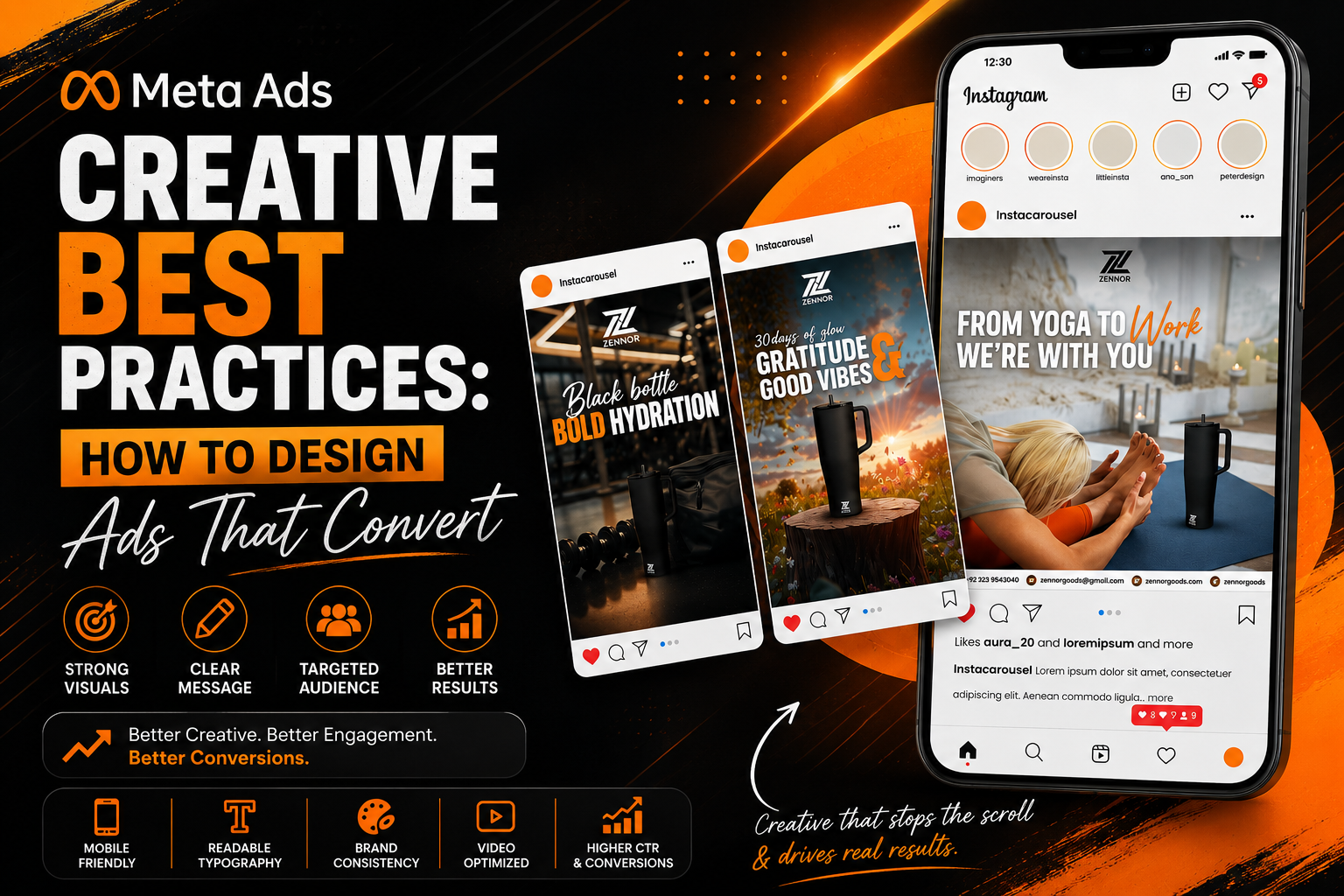
Meta Ads Creative Best Practices: How to Design Ads That Convert
Design
Meta Ads Creative Best Practices: How to Design Ads That Convert in 2026

You can have the perfect audience, an optimized campaign, and a healthy advertising budget—but if your creative fails to capture attention, your Meta Ads will struggle to deliver results. Creative is one of the biggest factors influencing the success of Facebook and Instagram advertising. Every day, users scroll past hundreds of posts, videos, stories, and advertisements. Your creative has only a few seconds to stop that scroll and convince someone to engage with your business. Many advertisers focus heavily on audience targeting and campaign settings while overlooking the element customers actually see first: the advertisement itself. An effective Meta ad creative combines strong visual design, persuasive messaging, clear branding, and an understanding of customer psychology. Whether you’re promoting a product, generating leads, or building brand awareness, the quality of your creative can significantly impact click-through rates, cost per lead, and overall return on ad spend. In this guide, we’ll share practical Meta Ads creative best practices that help businesses design advertisements that attract attention, build trust, and generate better results. Why Creative Is the Most Important Part of a Meta Ad Meta’s advertising algorithm has become increasingly sophisticated. It can optimize audiences, placements, and bidding strategies—but it cannot transform a weak creative into a high-performing advertisement. Your creative is what users notice first. It determines whether they stop scrolling or continue to the next post. A well-designed creative can: Simply put, better creative often leads to better campaign performance. Understand Your Audience Before Designing Every successful advertisement begins with understanding the customer. Before opening Photoshop, Illustrator, or Canva, ask yourself: For example: A startup founder searching for branding services responds to very different messaging than someone looking to purchase a gaming accessory. Your design, colours, imagery, and copy should reflect the needs and expectations of your target audience. Designing without understanding your audience often results in attractive ads that fail to convert. 1. Capture Attention Within the First Three Seconds People scroll quickly. If your advertisement doesn’t immediately communicate value, it will likely be ignored. Strong opening visuals include: The goal is to make someone pause long enough to understand what you’re offering. 2. Keep One Clear Message One of the most common mistakes in Meta advertising is trying to communicate too many ideas in a single ad. Instead of listing every feature or service, focus on one primary message. For example: ✔️ “Get a Complete Brand Identity Starting from $150” is far more effective than combining logo design, social media management, website development, video editing, and Meta Ads into one graphic. A focused message is easier to understand and more likely to generate action. 3. Use High-Quality Visuals Low-resolution images, inconsistent branding, and cluttered graphics reduce trust. Your creative should always look professional. Use: Quality visuals reflect the quality of your business. 4. Brand Your Creative Early Many advertisers forget to include their branding until the very end of the customer journey. Instead, your advertisement should subtly reinforce your brand from the first impression. Include elements such as: Avoid overwhelming the design with branding, but ensure customers remember who the advertisement belongs to. Consistency improves long-term brand recognition. 5. Design for Mobile First The majority of Meta users browse Facebook and Instagram on mobile devices. If your advertisement isn’t designed for smaller screens, you’re immediately limiting its effectiveness. When designing creatives: A design that looks perfect on a desktop monitor may become difficult to read on a mobile device. 6. Use Minimal Text Your creative shouldn’t become a poster full of information. Instead, let the design communicate visually while the caption provides additional context. A good rule is: Simple creatives are generally easier to understand and perform better in fast-scrolling environments. 7. Choose Colors That Support the Message Color influences emotion and helps direct attention. For example: Rather than selecting random colours, use a palette that aligns with both your brand identity and the emotion you want customers to experience. Consistent colour usage also strengthens brand recognition across campaigns. 8. Create a Clear Visual Hierarchy A high-performing Meta ad should guide the viewer’s eyes naturally. People shouldn’t have to search for the most important information. A simple visual hierarchy usually follows this order: Using size, spacing, contrast, and alignment correctly makes your advertisement easier to understand within seconds. When everything competes for attention, nothing stands out. 9. Include a Strong Call-to-Action Never assume people know what to do next. Every Meta ad should include a clear call-to-action (CTA). Examples include: Your CTA should feel like a natural next step—not a pushy sales message. It should also align with your campaign objective. For example, a lead generation campaign might use “Book a Free Consultation,” while an ecommerce campaign may perform better with “Shop Now.” 10. Build Trust with Social Proof Customers are more likely to engage with businesses that already have credibility. Whenever possible, include trust signals such as: For example: These elements reduce uncertainty and increase confidence before users even click the ad. 11. Use Human Faces Whenever Relevant People are naturally drawn to faces. Eye contact, expressions, and body language help advertisements feel more authentic and relatable. Human-focused creatives often perform particularly well for: For ecommerce or product-focused campaigns, lifestyle images showing products in use often outperform isolated product photos. 12. Design Videos for Silent Viewing A significant percentage of users watch Facebook and Instagram videos without sound. Your creative should communicate the message even if audio is turned off. Include: If someone understands your advertisement without listening, you’ve created a stronger user experience. 13. Maintain Consistent Branding Across Every Campaign Customers rarely convert after seeing a single advertisement. They often encounter multiple touchpoints before making a decision. Your Meta Ads should maintain consistency with: Consistent branding increases familiarity, and familiarity builds trust. Businesses with recognizable visual identities are often remembered long after users have stopped scrolling. 14. Test Multiple Creative Variations One advertisement is rarely enough. Professional advertisers continuously test different creative elements to identify what resonates with their audience. Variables worth testing include: Rather than
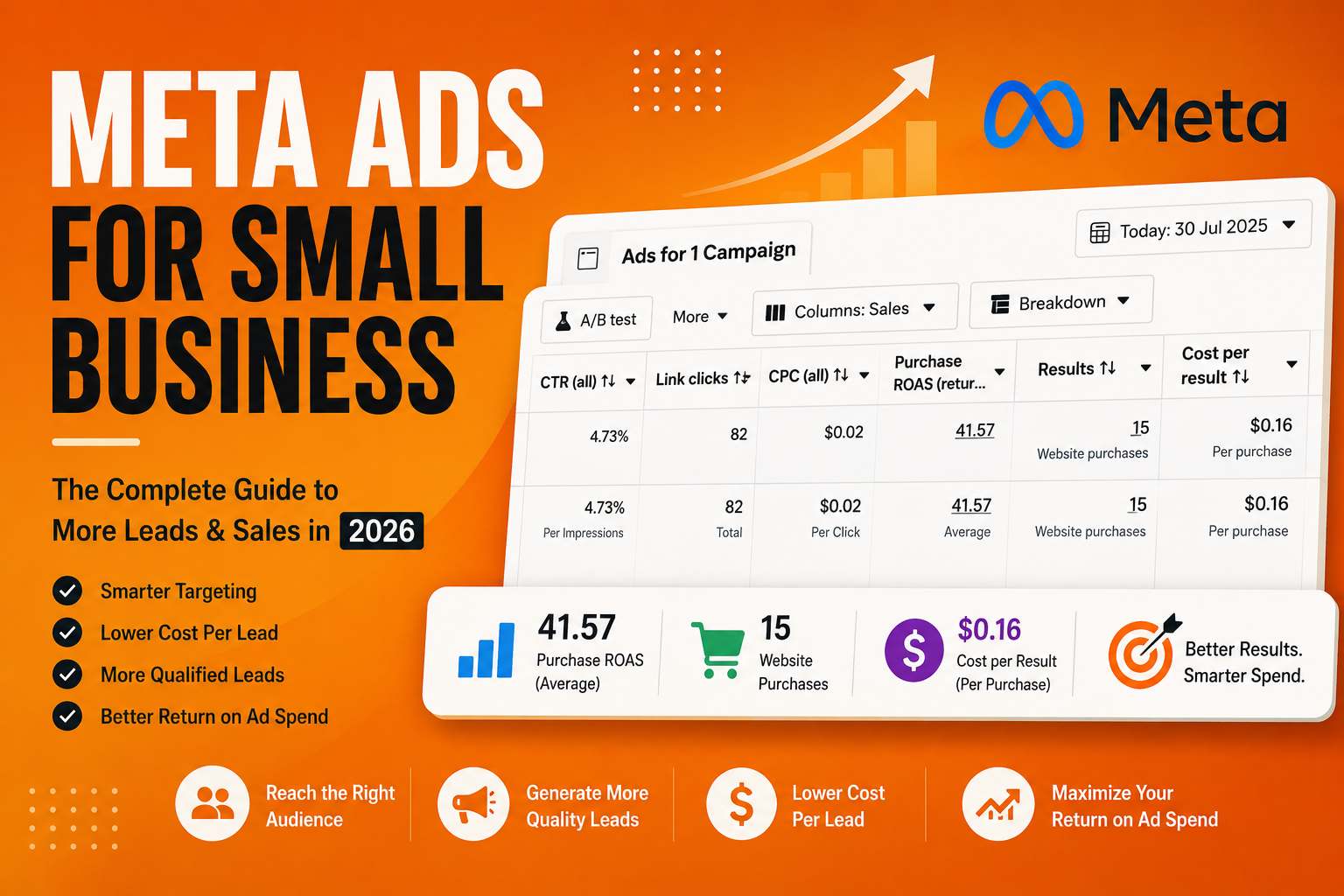
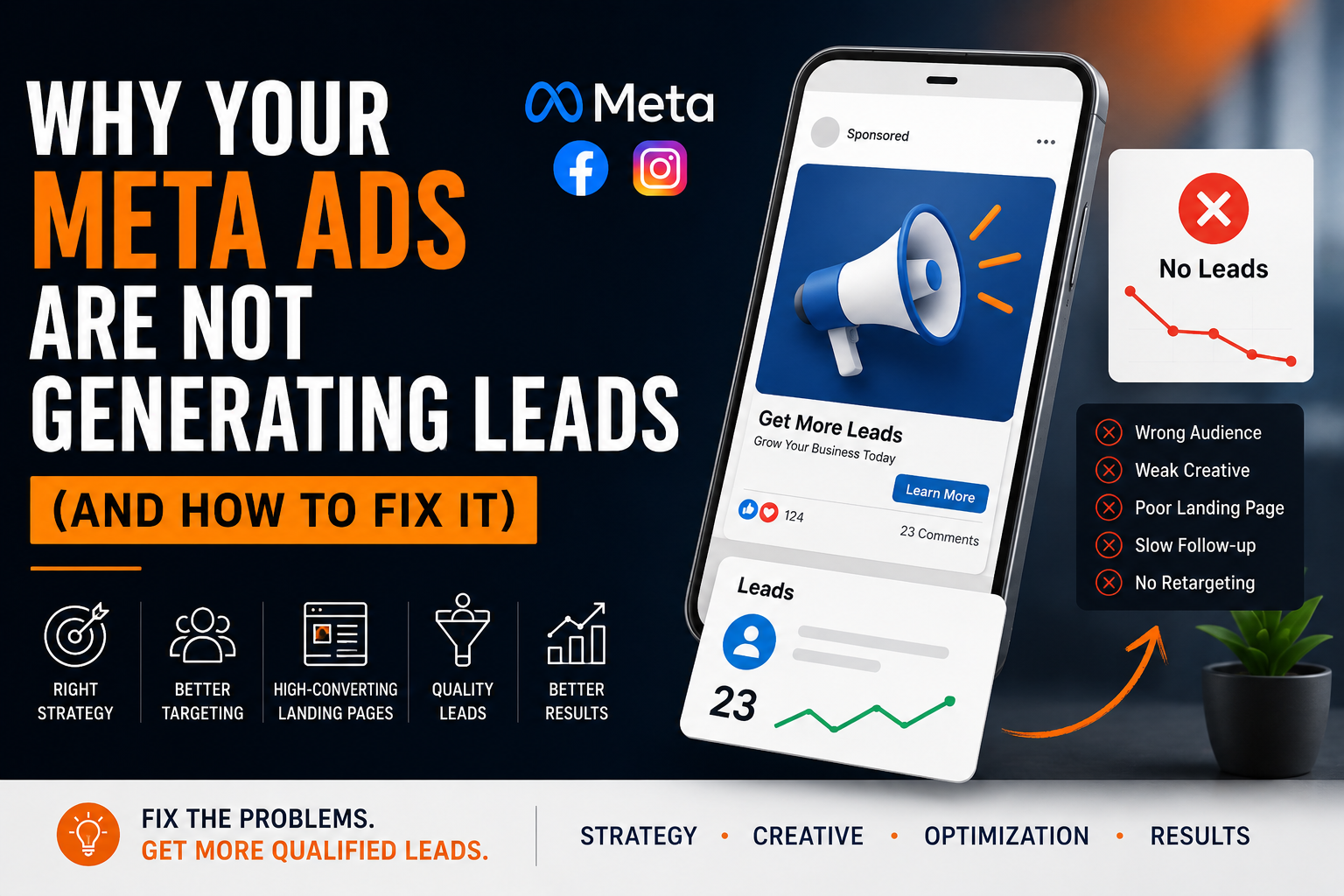
Meta Ads for Small Business featured image showing Meta Ads Manager dashboard, campaign performance metrics, and digital marketing elements illustrating lead generation and business growth.
Meta Ads
Meta Ads for Small Business: The Complete Guide to Getting More Leads and Sales in 2026

Every small business wants more customers. The challenge isn’t finding people who need your products or services—it’s reaching the right audience before your competitors do. Traditional advertising methods such as newspapers, billboards, flyers, and radio can still have value, but they often require larger budgets while offering limited targeting and difficult-to-measure results. Meta Ads have changed that. Today, even a small business with a modest advertising budget can reach thousands of potential customers through Facebook and Instagram. More importantly, those ads can be shown to people based on their location, interests, age, online behaviour, and buying intent. That’s why Meta Ads have become one of the most effective digital marketing channels for startups, local businesses, ecommerce stores, restaurants, real estate agencies, healthcare providers, and service-based companies. However, running Meta Ads successfully involves much more than simply clicking the “Boost Post” button. Many businesses spend money every month without generating quality leads because their campaigns are built without a clear strategy. In this guide, you’ll learn how Meta Ads work for small businesses, why they consistently outperform traditional advertising for many local companies, and how to build campaigns that generate qualified leads instead of wasting your marketing budget. What Are Meta Ads? Meta Ads are paid advertisements that appear across Meta’s advertising network, including: Using Meta Ads Manager, businesses can create highly targeted advertising campaigns designed to achieve specific marketing objectives such as: Unlike traditional advertising, Meta Ads allow businesses to control exactly who sees their advertisements. Instead of showing your ad to everyone, you can display it only to people who are most likely to become customers. This precision is one of the biggest reasons small businesses choose Meta Ads over many traditional advertising channels. Why Meta Ads Are Perfect for Small Businesses One of the biggest advantages of Meta Ads is accessibility. You don’t need a massive marketing budget to compete with larger businesses. A well-structured campaign with the right targeting and creative can often outperform businesses spending significantly more money. Here are some of the reasons Meta Ads continue to deliver excellent results for small businesses. Highly Targeted Advertising Instead of advertising to everyone, Meta allows you to target audiences based on: This means your advertising budget is focused on people who are genuinely interested in your products or services. Cost-Effective Marketing For many small businesses, every marketing dollar matters. Meta Ads provide complete control over your advertising budget. Whether you’re spending $10 per day or $500 per day, campaigns can be adjusted based on your business objectives and performance. Unlike many traditional advertising channels, you can pause, optimize, or scale campaigns whenever necessary. Measurable Results One of the biggest frustrations with traditional advertising is uncertainty. You rarely know exactly how many people responded to a newspaper advertisement or billboard. Meta Ads provide detailed performance metrics including: These insights allow businesses to make informed marketing decisions rather than relying on assumptions. Fast Lead Generation For service-based businesses, Meta Ads can begin generating enquiries within days rather than months. Businesses commonly use Meta Ads to receive: When campaigns are structured correctly, this creates a predictable flow of potential customers. Which Small Businesses Benefit Most from Meta Ads? Almost every business can benefit from Meta advertising. However, some industries consistently achieve excellent results because of the visual nature of Facebook and Instagram. Meta Ads are particularly effective for: Restaurants & Cafés Promote special offers, attract nearby customers, increase reservations, and showcase your menu through engaging visuals. Real Estate Agencies Generate qualified property enquiries through lead generation campaigns and targeted location-based advertising. Healthcare Clinics Reach local patients looking for healthcare services, consultations, and appointments while building trust within your community. Ecommerce Stores Increase online sales by promoting products directly to customers based on their shopping behaviour and interests. Educational Institutions Generate student enquiries for schools, colleges, academies, online courses, and training centres. Beauty Salons & Spas Promote services, attract appointment bookings, and build customer loyalty through targeted campaigns. Gyms & Fitness Centres Generate membership enquiries, advertise promotions, and encourage trial sign-ups using highly targeted local advertising. Professional Service Businesses Law firms, consultants, accountants, architects, agencies, and many other service providers can use Meta Ads to consistently generate qualified business enquiries. Why Many Small Businesses Fail with Meta Ads Despite Meta’s powerful advertising platform, many campaigns fail because businesses focus on advertising rather than strategy. Some of the most common mistakes include: Running Meta Ads successfully requires continuous testing, optimization, and data-driven decision-making. The businesses that consistently generate leads aren’t necessarily spending more—they’re making smarter advertising decisions. How to Build a Successful Meta Ads Strategy for a Small Business Many small businesses believe successful Meta advertising is simply about creating an attractive image and selecting a daily budget. In reality, every successful campaign is built on a complete marketing strategy. From audience research to campaign optimization, each stage influences the final result. Here’s what a professional Meta Ads strategy typically looks like. Step 1: Define a Clear Business Goal Before launching any campaign, determine exactly what success looks like. Different businesses have different objectives. For example: Choosing the correct campaign objective helps Meta’s algorithm deliver your ads to people most likely to complete your desired action. Launching campaigns without a clear objective often leads to wasted budget and poor-quality results. Step 2: Understand Your Target Audience One of Meta’s biggest strengths is its advanced audience targeting. Instead of advertising to everyone, successful campaigns focus on the people most likely to become customers. Important audience factors include: The more accurately your audience is defined, the more efficiently your advertising budget is spent. Step 3: Create High-Quality Ad Creatives Even the best targeting won’t save poor creative. Your advertisement has only a few seconds to capture attention before users continue scrolling. Effective Meta ad creatives usually include: Videos, carousel ads, lifestyle photography, testimonials, and user-generated content often outperform generic promotional graphics because they feel more authentic and engaging. Step 4: Write Ad Copy That Solves Problems People don’t click advertisements because businesses want

Why Your Meta Ads Are Not Generating Leads (And How to Fix It)
Meta Ads
Why Your Meta Ads Are Not Generating Leads (And How to Fix It)

You’re spending money every day. Your Meta Ads are getting impressions. People are clicking your ads. Some are even visiting your website. But your phone isn’t ringing. Your inbox is quiet. And the leads you do receive rarely become paying customers. Sound familiar? You’re not alone. One of the biggest misconceptions about Meta Ads is that simply launching a campaign guarantees leads. In reality, successful Meta advertising isn’t about spending more money—it’s about having the right strategy. Every day, thousands of businesses invest in Facebook and Instagram advertising expecting immediate results. When those results don’t come, many assume Meta Ads no longer work. The truth is different. Most campaigns fail because of avoidable strategic mistakes—not because the platform itself is ineffective. Whether you’re running Meta Ads yourself or working with an agency, identifying these mistakes can dramatically improve your campaign performance and generate more qualified leads without necessarily increasing your advertising budget. Let’s look at the most common reasons why Meta Ads fail to generate leads—and more importantly, how to fix them. Diagnosis #1: You’re Optimizing for Clicks Instead of Customers One of the biggest mistakes businesses make happens before their ads even go live. They choose the wrong campaign objective. Many advertisers select objectives like: because they produce impressive numbers. Thousands of clicks. Hundreds of likes. High engagement. But none of these metrics pay your bills. If your goal is generating enquiries, appointments, purchases, or qualified leads, optimizing for traffic alone often sends your ads to people who are simply more likely to click—not necessarily those who are ready to become customers. Meta’s algorithm learns from the objective you choose. If you tell Meta to find people who click, it will find people who click. If you tell Meta to find people who submit leads or complete purchases, it begins optimizing toward those outcomes instead. That’s a significant difference. How to Fix It Always start by asking one question: What business result am I trying to achieve? If your objective is lead generation, choose campaign objectives that optimize for: Success should be measured by customers—not clicks. Diagnosis #2: Your Ads Are Reaching the Wrong Audience Even the most creative advertisement will struggle if it’s shown to the wrong people. Audience targeting remains one of the most important factors in Meta Ads success. Many businesses make one of two mistakes. Targeting Too Broadly Trying to reach everyone usually means connecting with no one. Broad audiences often result in: Targeting Too Narrowly On the other hand, stacking dozens of interests together can severely limit Meta’s ability to optimize. Overly restrictive targeting often increases costs while reducing campaign performance. The goal isn’t finding everyone. The goal is finding the people most likely to become customers. How to Fix It Build audiences based on your actual customers rather than assumptions. Use a combination of: As your campaigns collect data, Meta’s algorithm becomes increasingly effective at finding similar users. The better your audience, the better your results. Diagnosis #3: Your Creative Isn’t Giving People a Reason to Stop Scrolling Meta is a visual platform. Your advertisement has only a few seconds—sometimes less—to capture attention. If your creative blends into the news feed, the campaign has already failed before anyone reads your headline. Many businesses use advertisements that look like every other ad online. Common problems include: Remember, people don’t open Facebook or Instagram looking for advertisements. They open these platforms to consume content. Your creative has to interrupt that scrolling behavior. Ask yourself: Would I stop scrolling to look at this ad? If the answer is no, your audience probably won’t either. How to Fix It High-performing Meta creatives usually have three things in common. A strong hook Capture attention immediately. A clear value proposition Tell people why they should care. A compelling call-to-action Guide them toward the next step. Good design helps. Great messaging converts. The most successful Meta campaigns combine both. Diagnosis #4: Your Offer Isn’t Compelling Enough Sometimes the problem isn’t your audience. It isn’t your creative. It isn’t even your budget. It’s your offer. Many businesses advertise services without giving customers a reason to take action today. For example: “Contact us today.” “Learn more.” “Visit our website.” These are calls-to-action. They are not offers. People respond to value. Not advertisements. Think about what would genuinely motivate someone to stop scrolling and trust your business. Examples include: A strong offer reduces hesitation. It gives potential customers a reason to act now instead of later. How to Fix It Before launching any campaign, ask yourself: Why should someone contact us today instead of next month? Your answer should become the foundation of your advertising campaign. Businesses rarely click because they love advertisements. They click because they believe the offer will solve a problem. Diagnosis #5: Your Landing Page Is Losing Potential Customers Many businesses assume that once someone clicks their ad, the hard work is over. In reality, that’s where the conversion process begins. A high-performing Meta Ad can still fail if it sends users to a poor landing page. Imagine clicking on an advertisement that promises a free consultation. The page takes several seconds to load. The design looks outdated. There’s no clear call-to-action. You have to scroll endlessly just to find contact information. Most visitors won’t wait. They’ll simply leave. This creates a common misconception: “My Meta Ads aren’t working.” When the actual issue is the destination page. A high-converting landing page should: Every unnecessary step between the click and the enquiry reduces your conversion rate. How to Fix It Instead of sending traffic to a generic homepage, create dedicated landing pages for your campaigns. Keep the design simple. Use one clear objective. Reduce distractions. Guide visitors toward a single action, whether it’s submitting a form, booking a consultation, or starting a WhatsApp conversation. Diagnosis #6: You’re Responding Too Slowly Generating leads is only half the job. Converting them is the other half. One of the biggest reasons businesses fail to see results from Meta Ads is slow follow-up.

meta ads vs google ads
Meta Ads
Meta Ads vs Google Ads: Which Drives Better ROI for Startups in 2026?

If you’re launching a startup, one of the first marketing decisions you’ll face is where to spend your advertising budget. Should you invest in Meta Ads and reach potential customers through Facebook and Instagram? Or should you focus on Google Ads and target people actively searching for your products and services? It’s a common question, and the answer can significantly impact your customer acquisition costs, lead quality, and overall return on investment (ROI). The truth is that both platforms can generate excellent results. However, they work very differently and are designed to achieve different marketing objectives. In this guide, we’ll compare Meta Ads and Google Ads, explain their strengths and weaknesses, and help startups determine which platform offers the best ROI in 2026. What Are Meta Ads? Meta Ads are advertisements that appear across Facebook, Instagram, Messenger, and Meta’s Audience Network. Unlike Google Ads, Meta Ads are based primarily on audience targeting rather than search intent. Instead of waiting for people to search for your business, Meta allows you to place your brand in front of highly targeted audiences based on factors such as: Meta Ads are often used for: Because Meta owns both Facebook and Instagram, businesses can reach billions of users through a single advertising platform. What Are Google Ads? Google Ads is Google’s advertising platform that allows businesses to display ads across: The most popular campaign type is Search Ads. These ads appear when users actively search for products, services, or information. For example: A user searching: “branding agency near me” or “Meta Ads management services” is already showing intent. Google Ads allows businesses to capture that intent and appear directly in front of potential customers at the exact moment they’re searching. Google Ads are commonly used for: Meta Ads vs Google Ads: Key Differences Although both platforms can generate leads and sales, they approach advertising differently. Intent vs Discovery This is the biggest difference. Google Ads Google captures existing demand. People already know they have a problem and are searching for a solution. For example: These users are actively looking to buy. Meta Ads Meta creates demand. Users are scrolling through social media when they discover your advertisement. They may not have been searching for your product, but compelling creatives can generate interest and conversions. Winner Google Ads for immediate purchase intent. Meta Ads for demand generation and audience building. Cost Per Click (CPC) Advertising costs vary by industry, competition, and location. However, Google Ads typically has higher CPCs because advertisers compete for valuable search traffic. Highly competitive industries often see expensive keywords. Examples include: Meta Ads generally offer lower CPCs because the platform focuses on audience targeting rather than keyword bidding. Winner Meta Ads usually provide lower traffic acquisition costs. Audience Targeting Meta Ads is one of the most powerful audience-targeting platforms available. Businesses can target users based on: Google Ads primarily targets based on search intent and keywords. While Google has audience targeting options, Meta remains stronger in this area. Winner Meta Ads Lead Quality This category depends heavily on the industry. Google users are often closer to making a purchase because they are actively searching for a solution. Meta users may require more nurturing before converting. For example: Someone searching: “branding agency in Pakistan” is likely further down the buying journey than someone casually browsing Instagram. Winner Google Ads for high-intent leads. Brand Awareness If nobody knows your brand exists, Google Ads can be limiting because it relies heavily on existing searches. Meta excels at introducing brands to new audiences. Startups often use Meta Ads to build visibility before customers begin searching for them. Winner Meta Ads Ecommerce Performance Both platforms perform exceptionally well for ecommerce businesses. However, they often serve different purposes. Meta Ads Excellent for: Google Ads Excellent for: The strongest ecommerce brands frequently use both platforms together. Winner Tie Speed of Results Google Ads can often generate leads quickly because you’re targeting people already searching. Meta Ads may require more testing and optimization before achieving consistent performance. However, once a Meta campaign is optimized, it can scale efficiently. Winner Google Ads Retargeting Capabilities Most users don’t convert on their first visit. Retargeting helps bring them back. Meta’s retargeting capabilities remain among the strongest in digital advertising. Businesses can show ads to: This helps improve conversion rates and maximize ROI. Winner Meta Ads Which Platform Is Better for Startups? The answer depends on your goals. Choose Meta Ads If: Meta Ads are particularly effective for: Choose Google Ads If: Google Ads often work well for: What Delivers Better ROI? This is the question most startups care about. The answer isn’t always Meta Ads. Also The answer isn’t always Google Ads. The answer is: The platform that aligns with your customer journey. If customers actively search for your service, Google Ads may generate better ROI. If customers need to discover your brand before considering a purchase, Meta Ads may outperform Google. Many successful businesses eventually use both platforms because they complement each other. Google captures demand. Meta creates demand. Together, they create a powerful marketing ecosystem. Common Mistakes Startups Make Choosing a Platform Based Only on Cost Lower CPCs don’t automatically mean higher ROI. Ignoring Customer Intent Understand how your customers buy before choosing a platform. Expecting Instant Results Advertising requires testing and optimization. Using Poor Creatives Even the best targeting cannot save weak advertisements. Not Tracking Conversions ROI cannot be measured without proper tracking. Meta Ads vs Google Ads: Final Verdict There is no universal winner. For startups focused on brand awareness, audience building, and demand generation, Meta Ads often provide exceptional value. For startups targeting customers actively searching for solutions, Google Ads can generate highly qualified leads and faster conversions. The most successful businesses rarely choose one platform forever. They use Google Ads to capture demand and Meta Ads to create demand. If you’re working with a limited budget, start with the platform that best matches how your customers discover and purchase your product or service. Ultimately, the best

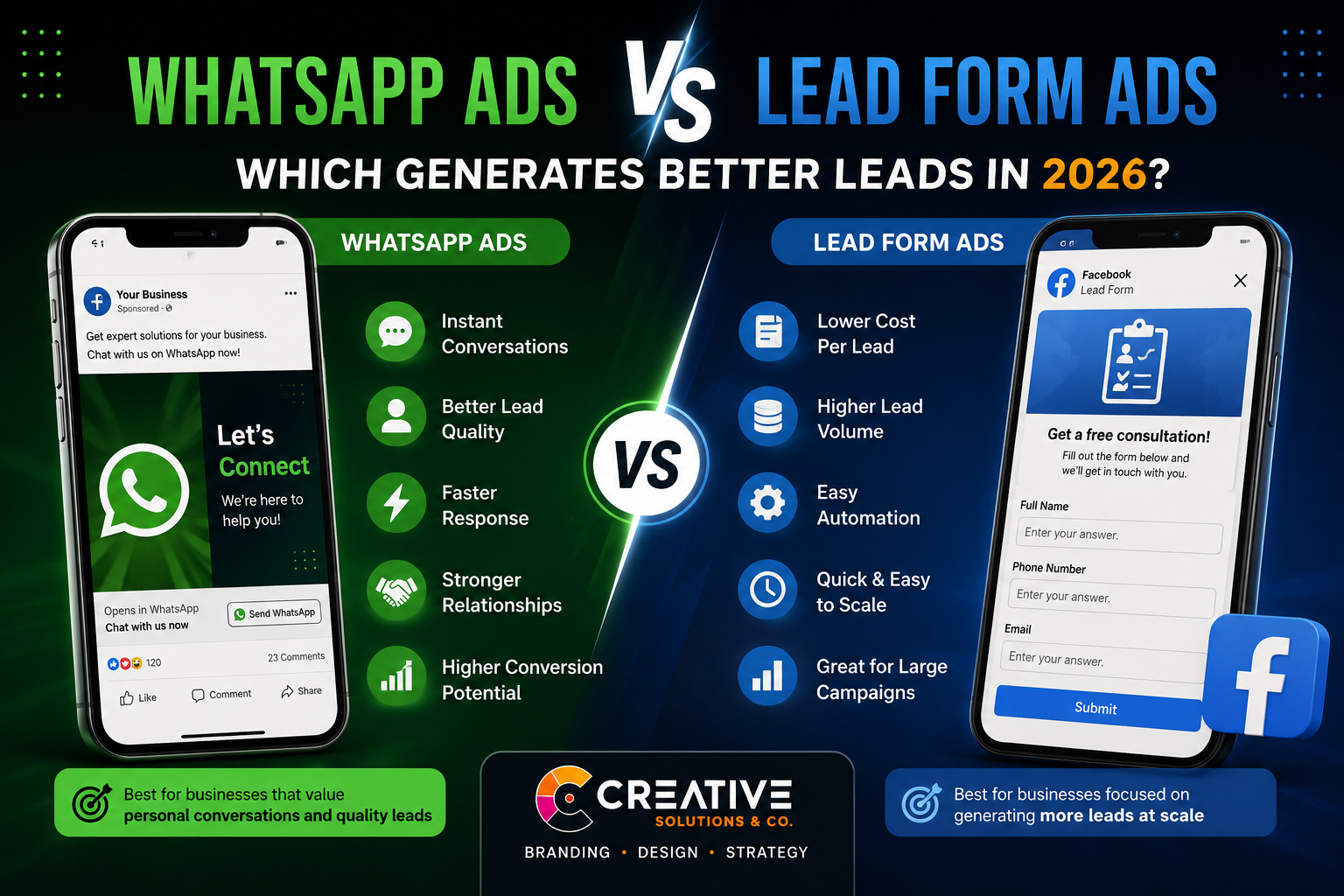
WhatsApp Ads vs Lead Form Ads comparison showing lead quality, cost per lead, conversion rates, and Meta Ads strategy for businesses in 2026
Marketing
WhatsApp Ads vs Lead Form Ads: Which Generates Better Leads in 2026?

If you’re running Meta Ads to generate leads, you’ve probably asked yourself one important question: Should I use WhatsApp Ads vs Lead Form Ads? It’s one of the most common decisions businesses face when launching Facebook and Instagram advertising campaigns. Both options can generate leads, but they work very differently and often produce different results depending on your industry, sales process, and goals. Some businesses prioritize getting the maximum number of leads at the lowest possible cost. Others care more about lead quality, conversion rates, and actual revenue generation. The truth is that there is no one-size-fits-all answer. In this guide, we’ll compare WhatsApp Ads and Lead Form Ads in detail, discuss their advantages and disadvantages, and help you determine which option is best for your business in 2026. What Are WhatsApp Ads? WhatsApp Ads are Meta advertisements that send users directly into a WhatsApp conversation when they click on your ad. Instead of filling out a form, prospects can instantly message your business and start a conversation. The process is simple: This creates a more personal and interactive experience compared to traditional lead generation methods. Benefits of WhatsApp Ads Disadvantages of WhatsApp Ads For service-based businesses, WhatsApp Ads often create a more direct path to conversion because prospects can ask questions and receive answers immediately. What Are Lead Form Ads? Lead Form Ads, also known as Instant Forms, allow users to submit their information directly within Facebook or Instagram without leaving the platform. When a user clicks your advertisement, a form opens containing fields such as: The information is automatically submitted and stored for follow-up. Benefits of Lead Form Ads Disadvantages of Lead Form Ads Lead Form Ads can generate a large volume of leads, but businesses often need a strong follow-up process to convert those leads into paying customers. WhatsApp Ads vs Lead Form Ads: Key Differences Let’s compare both options across the factors that matter most. 1. Lead Quality Winner: WhatsApp Ads Lead quality is often the most important factor for businesses. A WhatsApp lead has already taken an additional step by choosing to start a conversation. This usually indicates stronger intent and higher interest. In many industries, WhatsApp leads are more likely to respond, engage, and eventually convert into customers. Lead Form Ads often attract users who submit forms quickly without thoroughly evaluating the offer. As a result, businesses frequently report a higher percentage of unqualified leads from Instant Forms. 2. Cost Per Lead Winner: Lead Form Ads Lead Form Ads generally produce a lower cost per lead because the process is easier for users. Since Meta automatically fills much of the user’s information, submissions require very little effort. WhatsApp Ads usually generate fewer leads for the same budget because starting a conversation requires more commitment. If your primary goal is volume, Lead Form Ads often perform better. 3. Conversion Rates Winner: Depends on Your Sales Process Many businesses focus only on cost per lead. However, the real metric that matters is conversion rate. A campaign generating 100 cheap leads that never convert is less valuable than a campaign generating 20 highly qualified leads that become customers. Businesses with strong sales teams often achieve excellent results with WhatsApp Ads because they can engage prospects immediately. Businesses with automated follow-up systems may perform well with Lead Form Ads. The best approach is to evaluate leads based on revenue generated rather than lead volume alone. 4. Speed of Communication Winner: WhatsApp Ads Speed matters in sales. With WhatsApp Ads, communication begins immediately after the click. Potential customers can: This immediate interaction helps build trust and shortens the buying journey. Lead Form Ads introduce an extra step because the business must contact the lead after the form submission. Any delay can reduce conversion opportunities. 5. Automation and Scalability Winner: Lead Form Ads Lead Form Ads are easier to automate. Businesses can connect Meta forms to: For organizations handling hundreds or thousands of leads monthly, automation becomes essential. While WhatsApp automation tools exist, managing large volumes of conversations can still be challenging. When Should You Use WhatsApp Ads? WhatsApp Ads work particularly well for businesses that require consultation or discussion before making a sale. Examples include: Branding Agencies Clients often want to discuss pricing, timelines, and project requirements before committing. Marketing Agencies Prospects typically have questions about strategy, results, and budgets. Real Estate Companies Buyers want information about locations, pricing, and availability. Construction Companies Projects often require detailed discussions and quotations. Healthcare Providers Patients frequently need information before booking appointments. Consultants Consultation-based businesses benefit from direct conversations. If your business relies heavily on trust and relationship-building, WhatsApp Ads are often the better choice. When Should You Use Lead Form Ads? Lead Form Ads are ideal when speed and volume matter. They are particularly effective for: Recruitment Campaigns Collecting applications quickly from a large audience. Event Registrations Gathering attendee information efficiently. Educational Institutions Generating inquiries at scale. Insurance Companies Collecting prospect information for follow-up. Large Sales Teams Businesses with dedicated sales departments capable of handling large lead volumes. If your primary objective is collecting as many leads as possible, Lead Form Ads can be highly effective. Common Mistakes Businesses Make Regardless of which campaign type you choose, certain mistakes can reduce results. Responding Too Slowly The faster you respond, the higher your chances of conversion. Focusing Only on Cost Per Lead Cheap leads are not always profitable leads. Asking Too Many Questions Long forms often reduce conversion rates. Poor Ad Creatives Even the best campaign structure cannot compensate for weak ad creatives. No Lead Qualification Process Without qualification, sales teams waste time on unqualified prospects. No Follow-Up System Many businesses lose leads because they fail to follow up consistently. Which Option Generates Better Leads? For most service-based businesses, WhatsApp Ads tend to produce higher-quality leads because prospects engage in direct conversations before making decisions. For businesses focused on lead volume and automation, Lead Form Ads often generate more leads at a lower cost. The right choice depends on your objectives.

Meta Ads case study ecommerce growth
Case Study
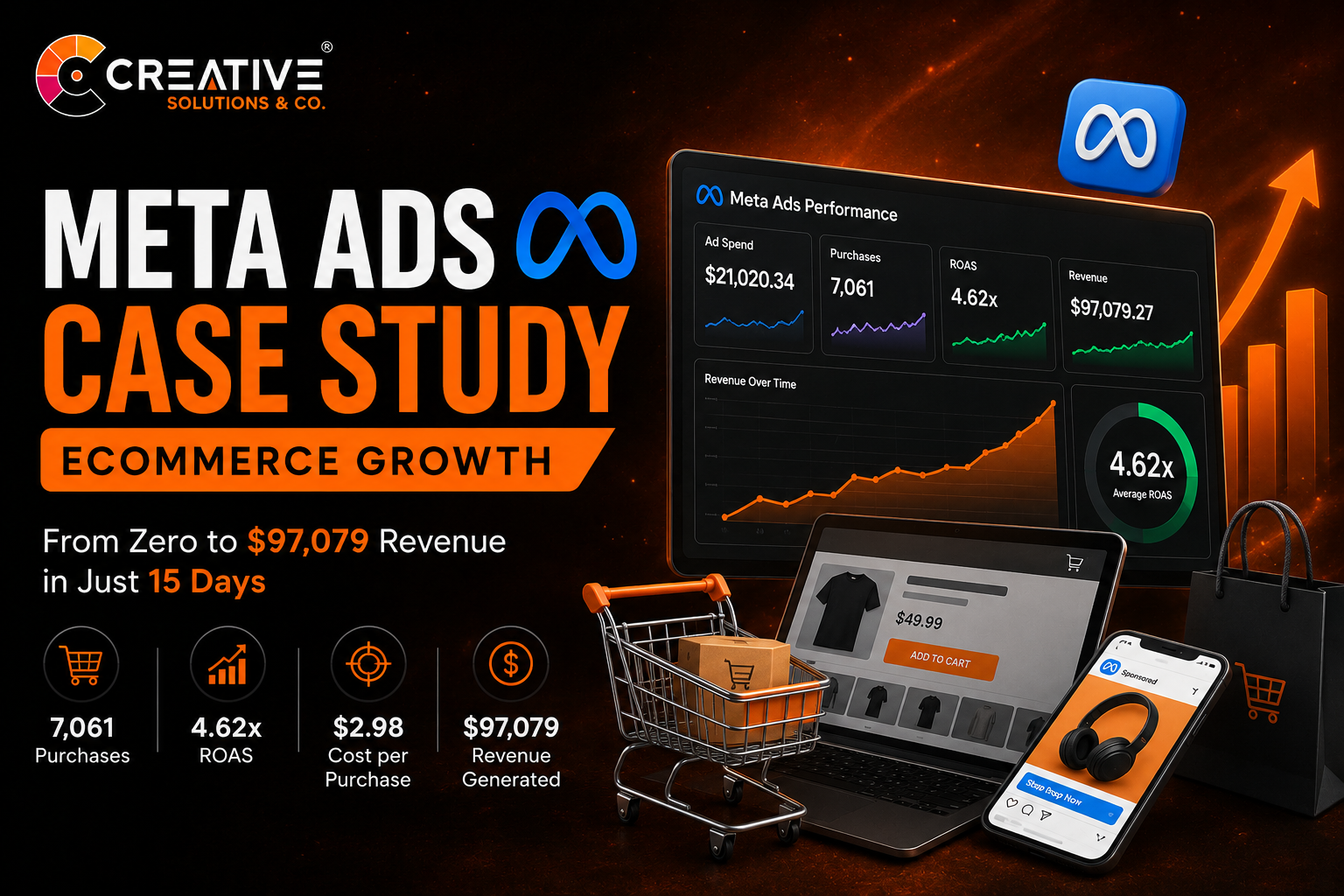
Meta Ads Case Study For Ecommerce Growth: From $0 to $97,079 Revenue in 15 Days

How We Scaled an Ecommerce Brand from Zero to $97,079 Revenue in 15 Days Using Meta Ads case study Launching a new ecommerce brand is difficult here is the meta ads case study for ecommerce growth Without historical purchase data, proven creatives, customer insights, or optimized audiences, most brands struggle to generate profitable sales in their early stages. The biggest challenge is not launching a store. The challenge is finding a scalable customer acquisition system that consistently generates revenue. In this Meta Ads case study, we’ll break down how our team helped an ecommerce brand go from zero sales to over $97,000 in tracked revenue within just 15 days using a structured Facebook and Instagram advertising strategy. If you’re looking for a Meta Ads agency that focuses on performance, testing, and scalability, this case study shows exactly how we approach ecommerce growth. The Challenge The brand approached us during its launch phase. Like most newly launched ecommerce businesses, it faced several challenges: This meant Meta’s algorithm had very little information available to optimize for purchases. Instead of looking for quick wins, our focus was building a foundation that could scale profitably. Our Meta Ads Strategy When launching a new ecommerce account, many advertisers make the mistake of scaling too aggressively before finding product-market fit. Our approach was different. We focused on three core pillars: 1. Creative Testing Creative performance determines the success of most Meta campaigns. We developed multiple creative variations focused on: This allowed us to identify winning messaging quickly and allocate spend toward the highest-performing creatives. 2. Data Collection Phase The first objective was not scale. The first objective was data. We launched multiple testing campaigns designed to gather: This accelerated Meta’s learning phase and improved optimization speed. 3. Purchase Optimization Once sufficient purchase signals were generated, budgets were gradually increased on winning ad sets. Rather than duplicating campaigns aggressively, we focused on controlled scaling to maintain efficiency and profitability. Campaign Results Within the first 15 days, the account achieved: Revenue Generated $97,079.27 Total Ad Spend $21,020.34 Total Purchases 7,061 Average Cost Per Purchase $2.98 Average Return on Ad Spend (ROAS) 4.62x These results demonstrate how a structured testing and scaling framework can rapidly accelerate ecommerce growth even without existing customer data. Top Performing Campaigns Not all campaigns perform equally. One of the biggest reasons advertisers struggle with Meta Ads is failing to identify winning assets early. The strongest-performing campaigns generated: Campaign #4 Key takeaway: This campaign demonstrated exceptional profitability and became a primary candidate for scaling. Campaign #2 Key takeaway: Consistent purchase volume with strong efficiency. Campaign #5 Key takeaway: Stable performance and strong scaling potential. Why Some Campaigns Underperformed Many business owners assume every campaign should generate a high ROAS immediately. That is not how successful Meta advertising works. Several test campaigns produced ROAS below 3x during the testing phase. This is normal. Testing is not wasted budget. Testing is how winning campaigns are discovered. We observed that lower-performing campaigns were primarily impacted by: These insights allowed us to redirect spend toward stronger-performing ad sets and improve overall account efficiency. Scaling Strategy Moving Forward Once profitable campaigns emerged, the next phase focused on sustainable growth. Our recommendations included: Increase Budgets Gradually Winning campaigns should be scaled incrementally by 20–30% per week to avoid disrupting Meta’s learning phase. Expand Retargeting Retargeting audiences were built around: Introduce Customer UGC User-generated content often becomes one of the strongest-performing creative formats for ecommerce brands. Launch Lookalike Audiences With new customer data available, lookalike audiences can help identify additional high-intent buyers. These strategies create a growth system capable of sustaining long-term profitability while increasing revenue. Key Lessons for Ecommerce Brands After managing Meta advertising campaigns across multiple industries, one pattern remains consistent: The brands that scale successfully focus on testing before scaling. The biggest lessons from this campaign include: Frequently Asked Questions How long does it take Meta Ads to become profitable? Most ecommerce campaigns require a testing period before achieving consistent profitability. The timeline depends on product demand, creative quality, pricing, and website conversion rate. What ROAS should an ecommerce business target? This varies by industry and margins, but many ecommerce brands aim for a minimum 3x ROAS while scaling. Are Meta Ads still effective in 2026? Yes. Meta remains one of the most powerful acquisition channels for ecommerce businesses due to its advanced machine learning capabilities and large audience reach. What is more important: targeting or creatives? Today, creatives often have a greater impact than audience targeting. Strong messaging and compelling content generally outperform highly complex targeting structures. Can a new ecommerce brand scale without existing customer data? Yes. This case study demonstrates how a brand with zero sales history successfully generated substantial revenue through strategic testing and optimization. Need Help Scaling Your Ecommerce Brand? At Creative Solutions & Co., we help ecommerce businesses generate more revenue through data-driven Meta Ads strategies, creative testing frameworks, and performance-focused campaign management. Whether you’re launching a new store or scaling an existing brand, our team can help you build a profitable customer acquisition system designed for long-term growth. Book a free consultation and discover how performance marketing can accelerate your ecommerce growth.